Micro-Business Marketing: Get Seen. Get Trusted. Get Paid
Get Seen, Get Trusted, Get Paid
If you’re running a micro business, you already know the truth: you don’t have a marketing department. You have you. And when you’re juggling delivery, admin, sales, and life, marketing can feel like a luxury—something you’ll “get to” once things calm down.
They rarely do.
That’s why micro-business marketing has to be simple, repeatable, and built around trust. Not hype. Not complicated funnels you’ll never maintain. Not jargon. And definitely not a 47-step “system” that requires three apps, two spreadsheets, and a mild personality change.
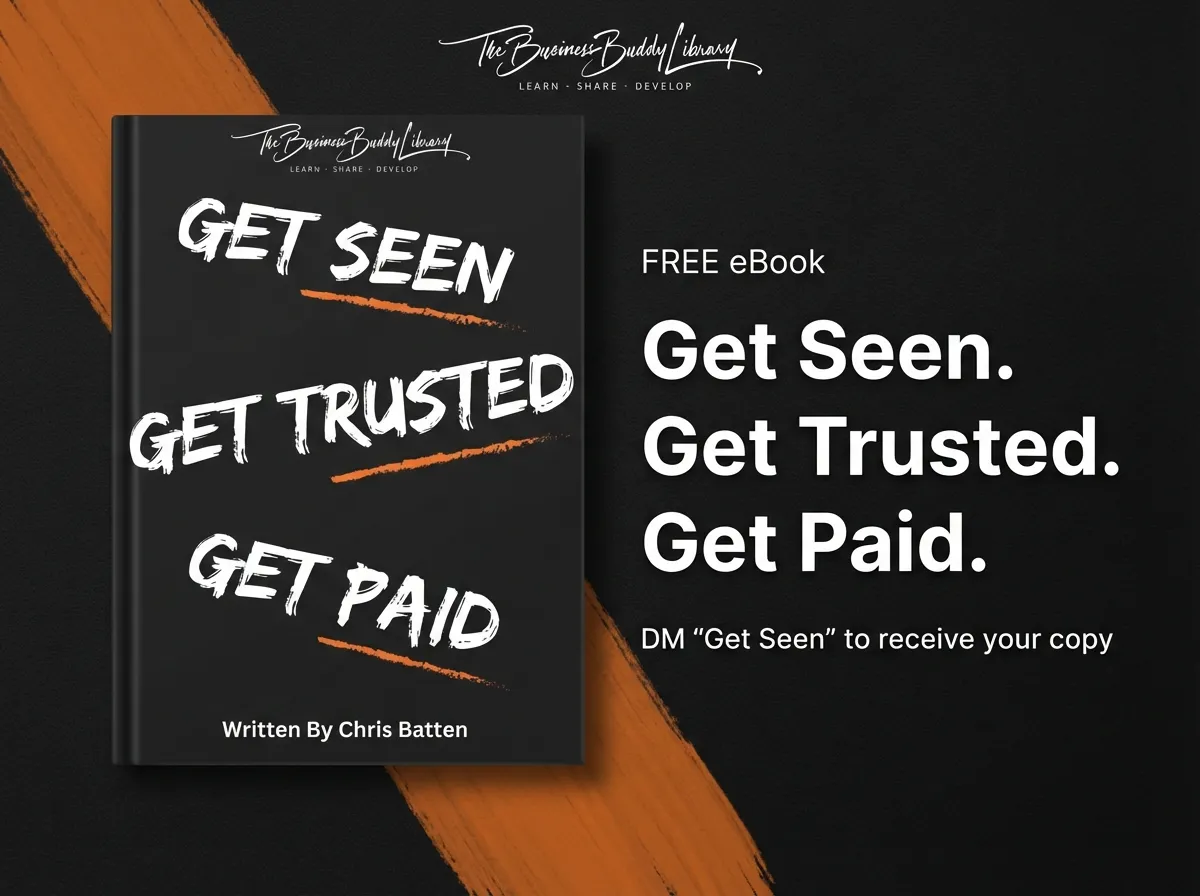
To help with that, I’ve created a free, practical e-book called Get Seen, Get Trusted, Get Paid—a set of straightforward marketing ideas you can actually execute, even if you’re short on time, budget, or confidence.
Why marketing feels hard for micro businesses (and why it doesn’t have to)
Most micro-business owners aren’t “bad at marketing.” They’re overwhelmed by noise.
You’ll hear:
“Post 3 times a day.”
“Run ads.”
“Build a funnel.”
“Start a podcast.”
“Do SEO.”
None of that is wrong. But it’s rarely helpful when you’re trying to get your next 5 customers.
Micro-business marketing works best when you focus on three outcomes:
Get seen by the right people
Get trusted quickly and consistently
Get paid without feeling salesy
That’s the backbone of the e-book—and the backbone of how we support subscribers inside The Business Buddy Library.
What the free e-book is (and who it’s for)
Get Seen, Get Trusted, Get Paid is for anyone who is:
Starting a micro business (or restarting after a wobble)
Running a service business and relying on referrals alone
Posting online but not getting enquiries
Unsure what to say, where to say it, or how often
Tired of marketing advice that sounds clever but doesn’t translate into action
It’s not theory. It’s a marketing catalyst—a clear set of ideas to help you build momentum.
A quick tour of what’s inside (and why it matters)
The book is structured as 16 simple ideas. Here are a few highlights, and why they matter for micro businesses.
Idea 1: Understand what marketing is
Marketing isn’t “posting on social media.” It’s not logos. It’s not ads.
At its simplest, marketing is:
Helping the right people understand what you do
Showing them you can be trusted
Making it easy to take the next step
When you get that clear, everything else becomes easier.
Idea 2: Change your view on strategy
Strategy doesn’t have to be a 40-page document. For micro businesses, strategy is simply deciding:
Who you’re for
What problem you solve
What you want to be known for
What you’ll do consistently (and what you’ll ignore)
That last part is underrated. “No” is a marketing strategy.
Idea 3: Nurture a community (or tribe)
Micro businesses win by building relationships, not by outspending competitors.
A community can be:
A small LinkedIn network
A local business group
A simple email list
A handful of repeat customers who refer you
You don’t need thousands. You need the right few who know you, like you, and remember you.
Idea 5 (A & B): Know your people & sell the impact
Most micro businesses describe what they do. Customers buy why it matters.
Instead of:
“I’m a bookkeeper.”
Try:
“I help small business owners stop worrying about their numbers so they can make decisions with confidence.”
That shift—towards impact—makes your marketing instantly more compelling.
Idea 6: Your content creation compass
Content becomes easier when you stop trying to be clever and start being useful.
A simple compass:
What do people ask you all the time?
What do they get wrong?
What are they worried about?
What’s the first step you wish they’d take?
Answer those consistently and you’ll never run out of content.
Idea 7: Design your customer journey
Micro-business marketing is not about one perfect post. It’s about a journey.
People typically need to:
Discover you
Understand you
Trust you
Take a small step
Buy
If you build marketing that supports each step, sales becomes a natural outcome—not a pushy moment.
Idea 9: Your website
Your website doesn’t need to be fancy. It needs to be clear.
At minimum, it should answer:
Who is this for?
What problem does it solve?
What do I do next?
If someone has to “work it out”, they won’t. They’ll just keep scrolling.
Idea 10–Idea 13: Social media, long-form content, email, and content marketing
These work best together.
Social media builds visibility and familiarity
Long-form content builds authority and depth
Email builds relationship and consistency
Content marketing turns your expertise into an asset
You don’t need to do everything. But you do need a system that you can maintain.
Idea 14–Idea 16: Likeability, storytelling, and consistency
People buy from people they like—and people trust people who show up.
A simple approach:
Be human (professional, but human)
Tell real stories (not just achievements)
Stay consistent (because trust is built in repetitions)
Consistency beats intensity.
Why this matters (especially if you’re in years 1–“we’re still figuring it out”)
In the early years, the biggest risk isn’t competition. It’s invisibility.
If people don’t know you exist, they can’t buy from you. If they don’t trust you, they won’t refer you. If you don’t have a simple way to stay in touch, you’ll keep starting from scratch.
That’s what this e-book is designed to fix.
How this connects to The Business Buddy Library
The free e-book is a window into what we do inside The Business Buddy Library.
Subscribers get:
Practical, plain-English resources (e-books, audio, video)
Regular business development “surgeries” (interactive support)
Ongoing guidance to help you apply what you’re learning
In other words: not just information—implementation support.
Want the free e-book?
If you’d like a copy of Get Seen, Get Trusted, Get Paid, DM me the words “Get Seen”.
If you’d like, add one sentence on what you do and what’s stuck (visibility, trust, or sales) and I’ll reply with the e-book and one practical next step you can use this week.
If marketing has been feeling messy, confusing, or inconsistent—start here. Keep it simple. Build trust. Create momentum.
Raise the colours (quietly)
You don’t need to be louder than everyone else.You need to be clearer, more consistent, and more helpful.
Get seen. Get trusted. Get paid.