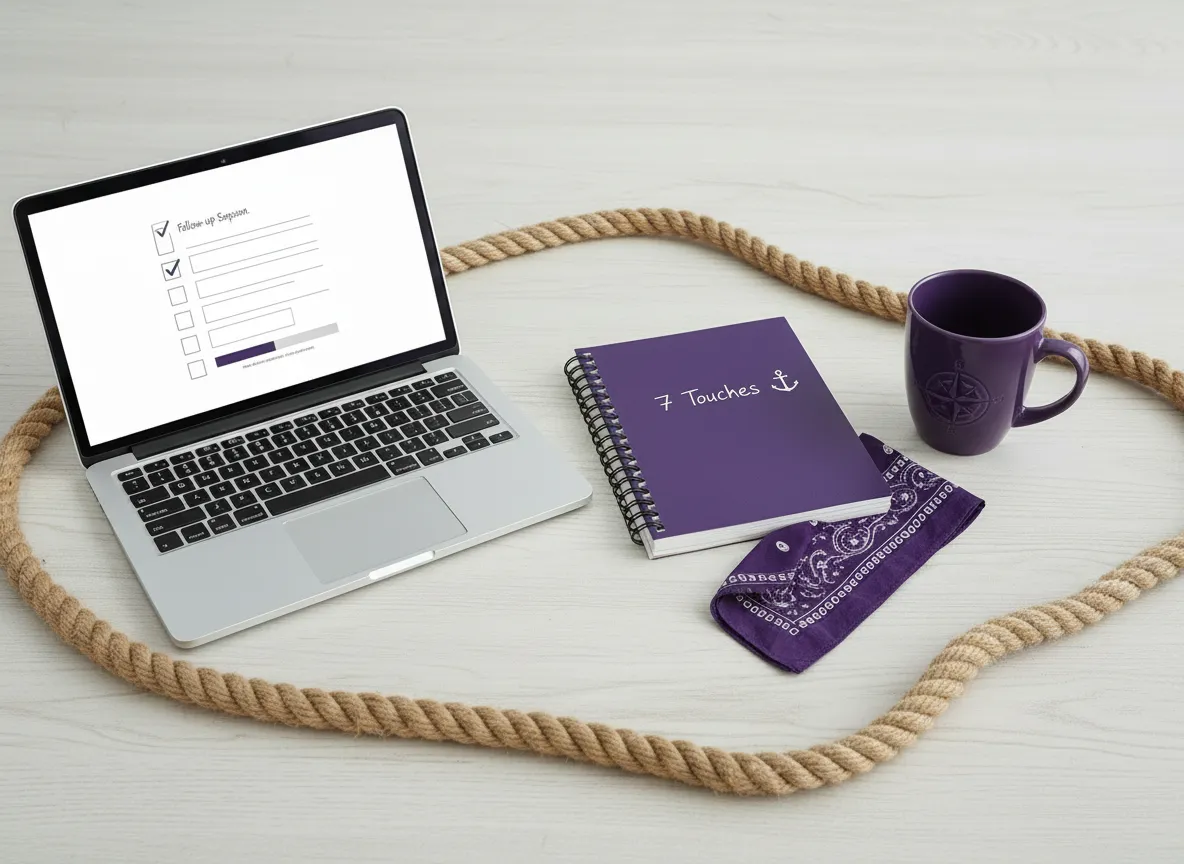
Follow-Up System for Micro Businesses (7 Touches)
The 7-Touch Follow-Up Rule: Why Your “No Reply” Isn’t a No (Yet)
You know that lead who said “Sounds good” … and then vanished?
Here’s the uncomfortable truth: most “ghosting” isn’t rejection — it’s life. Busy inbox. School run. Client drama. A dozen tabs open. Decision fatigue.
So today, let’s give you a follow-up system that feels human, not desperate. A simple 7-touch rhythm that helps you stay visible, stay professional, and get paid — without chasing people like a debt collector.
The day the Purple Pirate nearly walked away from money
A while back, I spoke to a founder who ran a brilliant little service business. Great results. Great reviews. Proper graft.
They told me, “I had three enquiries last month. I sent quotes. Heard nothing back. So I assumed they weren’t serious.”
I asked one question:
“How many times did you follow up?”
Answer: Once. (And it was basically: “Just checking you got my email.”)
That’s not a follow-up. That’s a polite wave as the ship sails away.
Here’s what happened when they used a simple follow-up sequence instead:
One lead replied: “Sorry — crazy week. Yes, let’s do it.”
Another said: “We picked someone else, but can you help next month?”
The third admitted: “I want to do it, I’m just nervous about spending.”
None of those were “no.” They were “not yet.”
And that’s the whole game for micro-businesses: turning “not yet” into “yes” with calm consistency.
Why follow-up works (and why it feels awkward)
Let’s name the real fear: follow-up can feel like you’re being pushy.
But in reality, good follow-up is:
clarity (so people can decide)
confidence (so you don’t spiral)
service (so they don’t get stuck)
If you help people buy with less stress, you’re not annoying them — you’re leading them.
The 7-touch follow-up system (simple, not spammy)
Touch 1 (Day 0): The quote/proposal + a decision question
When you send the quote, don’t end with “Let me know.”
End with a decision question:
“Do you want to start next week or the week after?”
“Would you like the standard option or the faster turnaround option?”
People don’t ignore quotes. They ignore uncertainty.
Touch 2 (Day 2): The “quick check + one helpful line”
Keep it short. One screen. No essays.
Example: “Quick one — did you want me to hold a slot for you next week?
If budget’s the sticking point, tell me, and I’ll suggest a smaller first step.”
This works because it gives them an easy out and an easy yes.
Touch 3 (Day 5): Add proof (without showing off)
This is where you bring receipts: a result, a mini case study, a testimonial.
Example: “Sharing this in case it helps: I helped a similar business [result].
If you want, I can outline what I’d do in week 1 for you.”
Proof reduces risk. Risk is what causes silence.
Touch 4 (Day 9): The “two options” follow-up
People love choices. It feels safer than a yes/no.
Example: “Still open on your side?
Option A: we start with the full package.
Option B: we do a smaller ‘starter sprint’ and build from there.”
Touch 5 (Day 14): The gentle deadline (capacity, not pressure)
Deadlines work when they’re real.
Example: “I’m planning next week’s workload today — should I keep a slot open for you, or close this off for now?”
This is professional. It’s not begging. It’s boundaries.
Touch 6 (Day 21): The “break-up email” (polite, confident)
This one is magic when done right.
Example: “I haven’t heard back, so I’m going to assume timing isn’t right.
No problem at all — if you want to pick this up later, reply with ‘Later’ and I’ll check in next month.”
You’re giving them a low-effort reply. That’s the trick.
Touch 7 (Day 30–45): The re-open with value
Not “just checking in.” Bring something useful.
Example: “Thought of you — here’s a quick idea to improve [their goal].
If you want me to help implement it, I’ve got two slots next month.”
The follow-up mindset shift (this is the emotional intelligence bit)
Follow-up isn’t about “getting the sale.”
It’s about being the calm, consistent adult in the room while your prospect is juggling:
fear of wasting money
fear of choosing wrong
fear of change
fear of being sold to
Your job is to make the decision feel safe.
That’s Purple Pirate leadership: steady hand on the wheel, even when the sea’s messy.
A tiny system to make this automatic (so you actually do it)
You don’t need fancy tech. Use a simple tracker:
What to track for every lead
Name + contact
What they want
Date you sent quote
Next follow-up date
Which “touch” number they’re on
The rule
Every workday, follow up with 3 people.
That’s it. That’s the whole treasure map.
Key takeaways
Follow-up isn’t pushy when it’s helpful, clear, and respectful.
Most “no reply” is “not yet” — your job is to stay visible.
Use a 7-touch rhythm over 30–45 days instead of one awkward nudge.
Add proof, options, and boundaries — not paragraphs and panic.
Track leads simply and follow up with 3 people a day to build momentum.
The offer
If you want this kind of practical, plain-English support (with zero fluff and a bit of Purple Pirate mischief), come join The Business Buddy Library.
Inside the membership, you get:
Monthly resources that break down marketing and sales in a way you can actually use
Online Business Development Surgeries (Zoom) — bring your real situation, get real next steps
Ongoing support so you’re not stuck Googling at midnight
Start here:
Join the membership: https://thebusinessbuddylibrary.com/subscription
And don’t miss the free bonus gift:
Grab the free ebook: “Get Seen, Get Trusted, Get Paid” (available on the subscription page)
https://thebusinessbuddylibrary.com/subscription
If you’re ready to stop losing sales to silence, join the crew — and bring your follow-up messages to the next Surgery. We’ll tighten them up together.
Short checklist summary
Follow-Up System Checklist
Send quote with a decision question
Schedule Touch 2 (Day 2): quick check + helpful line
Schedule Touch 3 (Day 5): proof/testimonial
Schedule Touch 4 (Day 9): two options
Schedule Touch 5 (Day 14): capacity-based deadline
Schedule Touch 6 (Day 21): polite close-the-loop message
Schedule Touch 7 (Day 30–45): re-open with value
Track leads + follow up with 3 people every workday
Sources: